How to update app prices safely: versioning, history, and rollback
Pricing automation without preview, history, and rollback is just faster manual work. Here's how to treat app pricing like code.

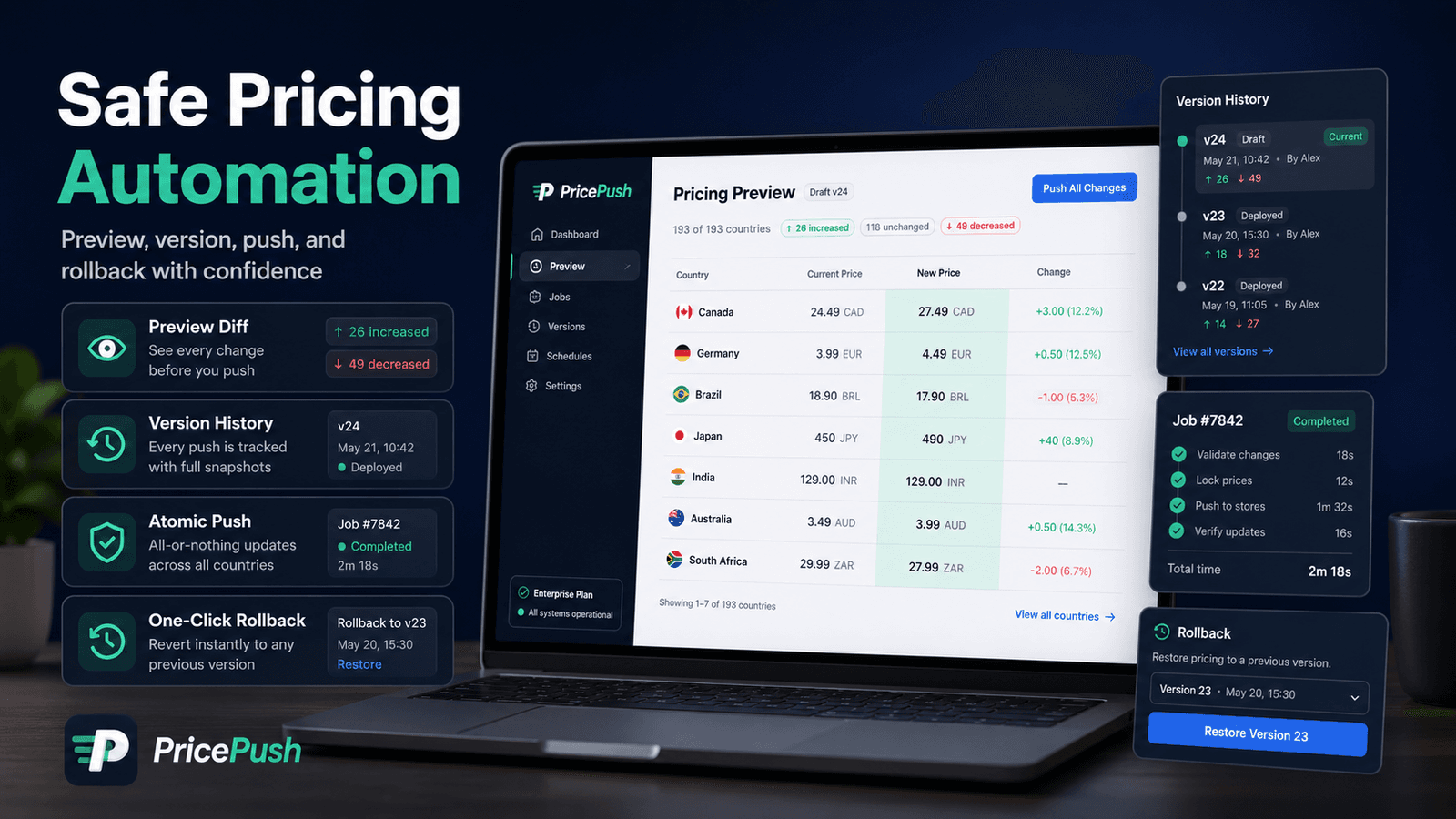
The first time I pushed prices to 175 countries from a script, I sat there for thirty seconds with my hand off the trackpad before clicking. Not because the math was wrong. Because I had no idea what would happen if it went wrong.
That feeling, between “I trust my code” and “I’m about to commit to production for the entire planet,” is what most pricing automation skips over. It treats every push as a one-way commit. No preview, no diff, no history, no undo. Treating pricing like code, with preview, versioning, history, atomic push, and rollback, is the difference between automation and safe automation.
The fear is rational
Pushing wrong prices to 175 countries is not a typo you can fix in five minutes.
For example: under-price to 20% of intended for 24 hours in Brazil, and anyone who subscribes during that window is locked in at the wrong rate. On annual subscriptions, that’s a year of revenue you can’t recoup. The inverse, over-pricing India by 3x for a week, doesn’t show up on the day it happens. You see it three months later as flat conversions, then six months later as higher churn from the cohort that did convert.
The blast radius is huge in both directions, and detection is slow. By the time the data tells you something is wrong, it’s already wrong for thousands of users.
Pricing tools that don’t take this seriously are not, strictly speaking, finished. They automate the easy part. The hard part is everything that has to be true before you’d trust the automation.
Engineers solved this for code 20 years ago
Look at how a developer ships code in 2026. A branch, a diff in the pull request, a reviewer, often a CI pipeline. The merge produces a commit with an SHA, author, timestamp, and parent. If something breaks, git revert is two commands and a deploy.
Now look at how most app pricing gets shipped. Open App Store Connect. Open the price-tier dropdown for one country. Click. Save. Hope. Repeat 174 times. No diff, no commit ID, no parent. The only “version control” is whatever you wrote in your notes app the night before.
I had this realization staring at the pricing UI one evening. I would never ship a 200-line refactor without a PR. But I was about to push 4,000 territory-by-product price changes, irreversibly, by clicking through a console. The asymmetry is absurd once you notice it.
Pricing is code. It’s a function that takes a base price and outputs a number per country. Inputs (FX rates, PPP indices, rounding rules), logic (the strategy), side effects (every checkout). It living in a console UI instead of a repo doesn’t change what it is. The right tools are the same: diffs, versions, history, atomic application, rollback.
What “safe automation” actually means
Five properties, each answering a different “what if I screw up” question.
Preview before commit
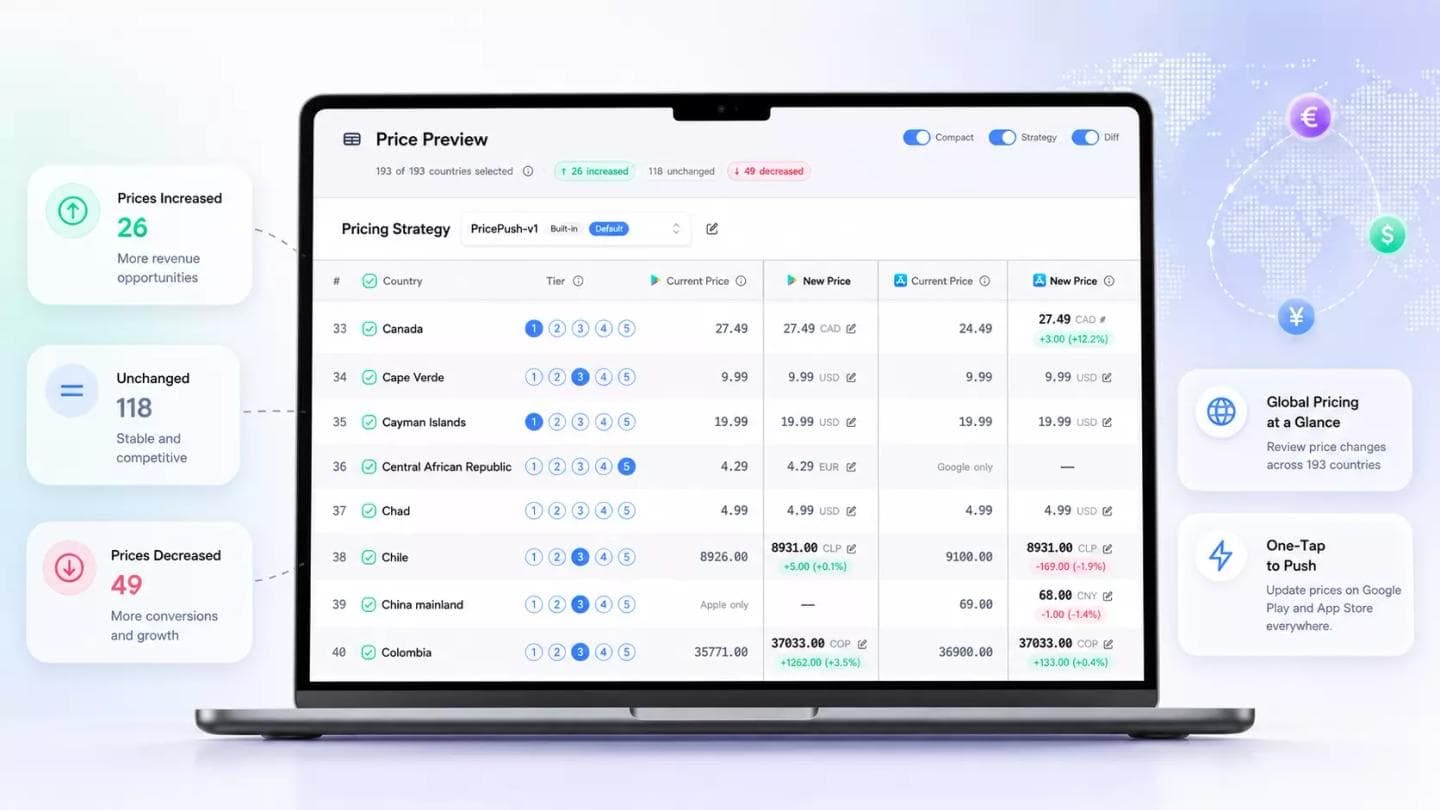
Before any push, see the full diff. Old price, new price, currency, country, with manual overrides flagged separately from strategy-generated rows.
This matters more than people expect. Apple uses a price-point ladder, so “₹449 in India” maps to the nearest tier, and the ladder differs per territory. Custom rounding rules can produce results that read clean in your strategy (”end every price in 9”) but look wrong in a specific currency. A diff catches both before they ship.
You wouldn’t merge a PR without looking at the diff. Pricing isn’t different.
Versioning
Every push gets an ID. Every strategy gets a name. Both snapshotted at push time.
Two different kinds of versioning. The push ID identifies a specific event (”on May 3rd at 14:22, I pushed these 175 prices”). The strategy snapshot identifies the rule that generated it (”PricePush-v1 with custom Tier 5 multiplier 0.30”). One lets you point at an event. The other lets you reproduce or compare strategies fairly. Snapshotting the strategy alongside the prices is what lets you both reproduce a past state and explain why each price landed where it did, not just what number was pushed.
History
What was the price in India 30 days ago? Was it a strategy push, an FX rebalance, a manual override, or a base-price change?
Real reasons I’ve needed this: a user in Turkey says they were charged more than the website advertised, and I want to know if the website was stale or I pushed wrong. Before raising a base price 20%, comparing conversions in Brazil during the last two strategies. A future me asking “why is this country at this number?” and getting a row in a table, not a Slack archaeology dig.
History is the audit trail. It separates “I think this is right” from “I can prove it.”
Atomic push
If a push touches 175 countries, the worst outcome is “succeeded for 130, failed for 45, no clear way to know which.” Half-applied state and no way to tell from the dashboard without diffing every country by hand.
The right answer is atomic with retries. Either the whole product flips for the targeted territories, or partial state is recorded and retried automatically. Cross-store pushes need framing too: App Store Connect and Google Play are two APIs with two rate-limit regimes. “Push to both stores in one tap” means “queue two atomic jobs from one click,” not “two stores commit as one transaction.” Recovery has to be visible, not silent.
Rollback
One click to undo a push. The system already has the old prices, it recorded them when it pushed the new ones. Restore is just “push the old changes payload back.”
Rollback is a backstop, not the moment you’re optimizing. The moment you’re optimizing is the preview, three steps earlier, when the bad push doesn’t happen at all. Rollback exists so the preview step earns the trust it needs.
How PricePush implements each
Preview. The Localize page renders a full per-country price grid before any push. Override any cell manually, and the override is flagged on the row. Numbers reflect Apple’s price-point ladder and your rounding rules, so the preview is what will ship.
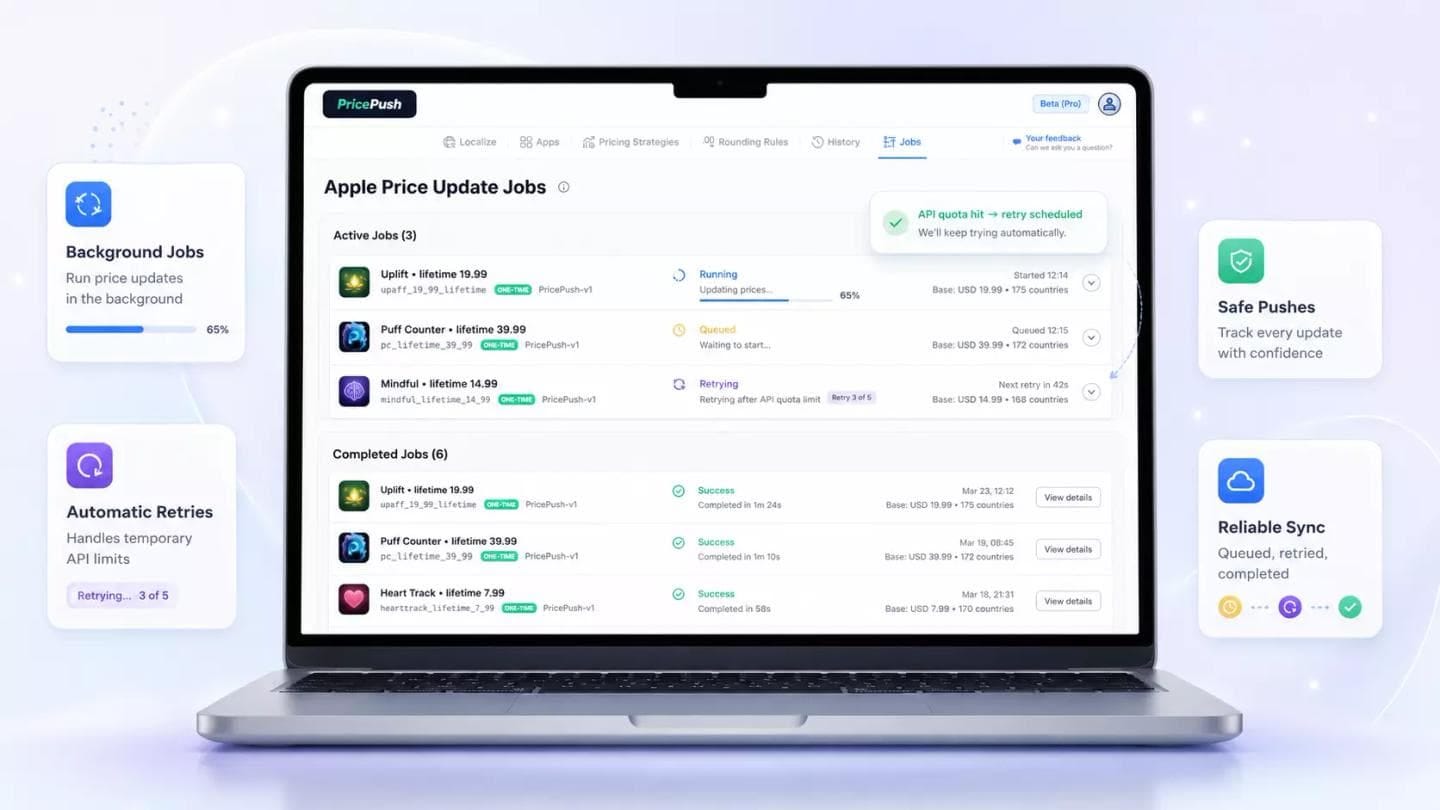
Versioning. Every push gets a job ID with timestamp, attempts counter, and a lifecycle status (queued, running, done, error, cancelled). Pricing strategies live as named templates. At push time the strategy ID and name are snapshotted into both the job and the history row, with manual overrides tracked separately.
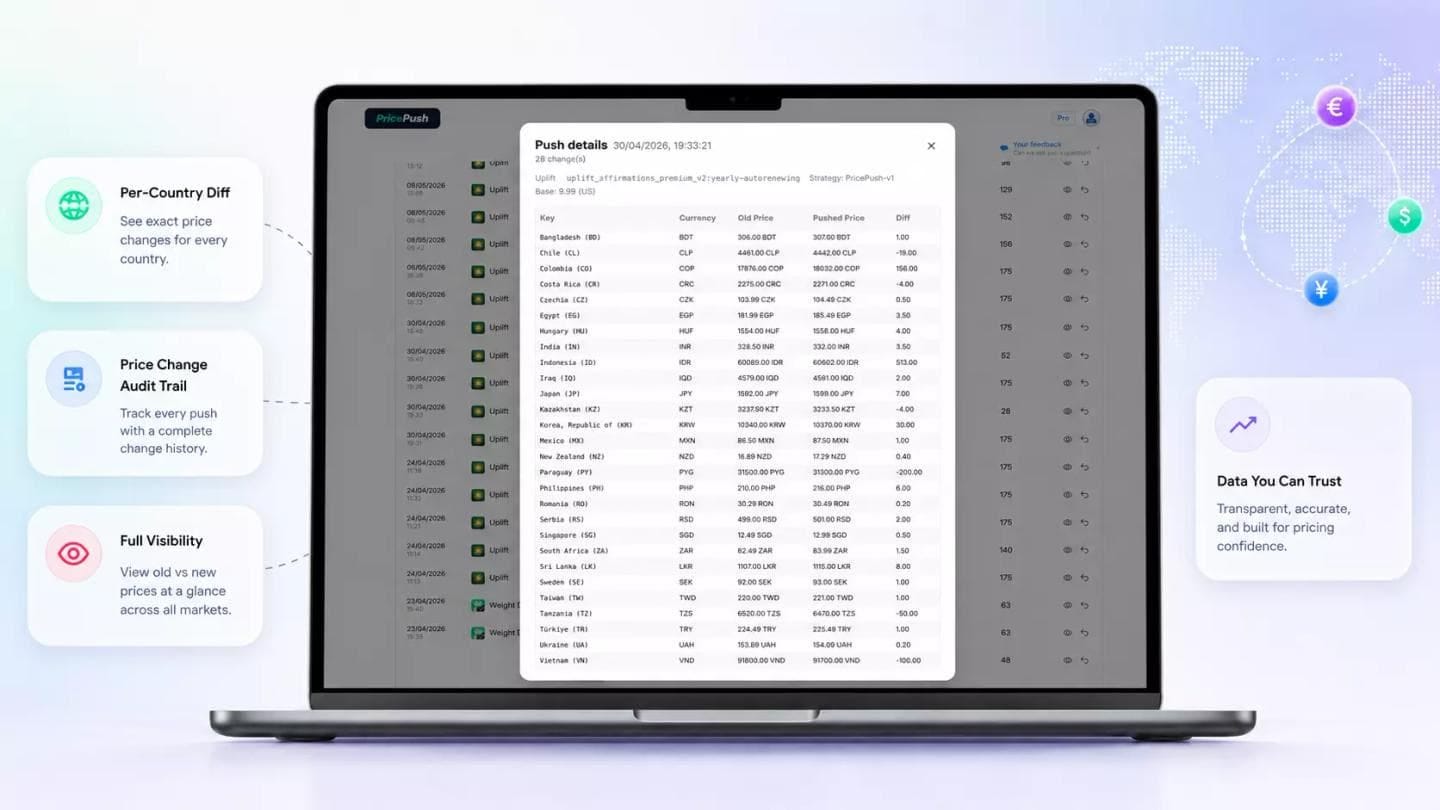
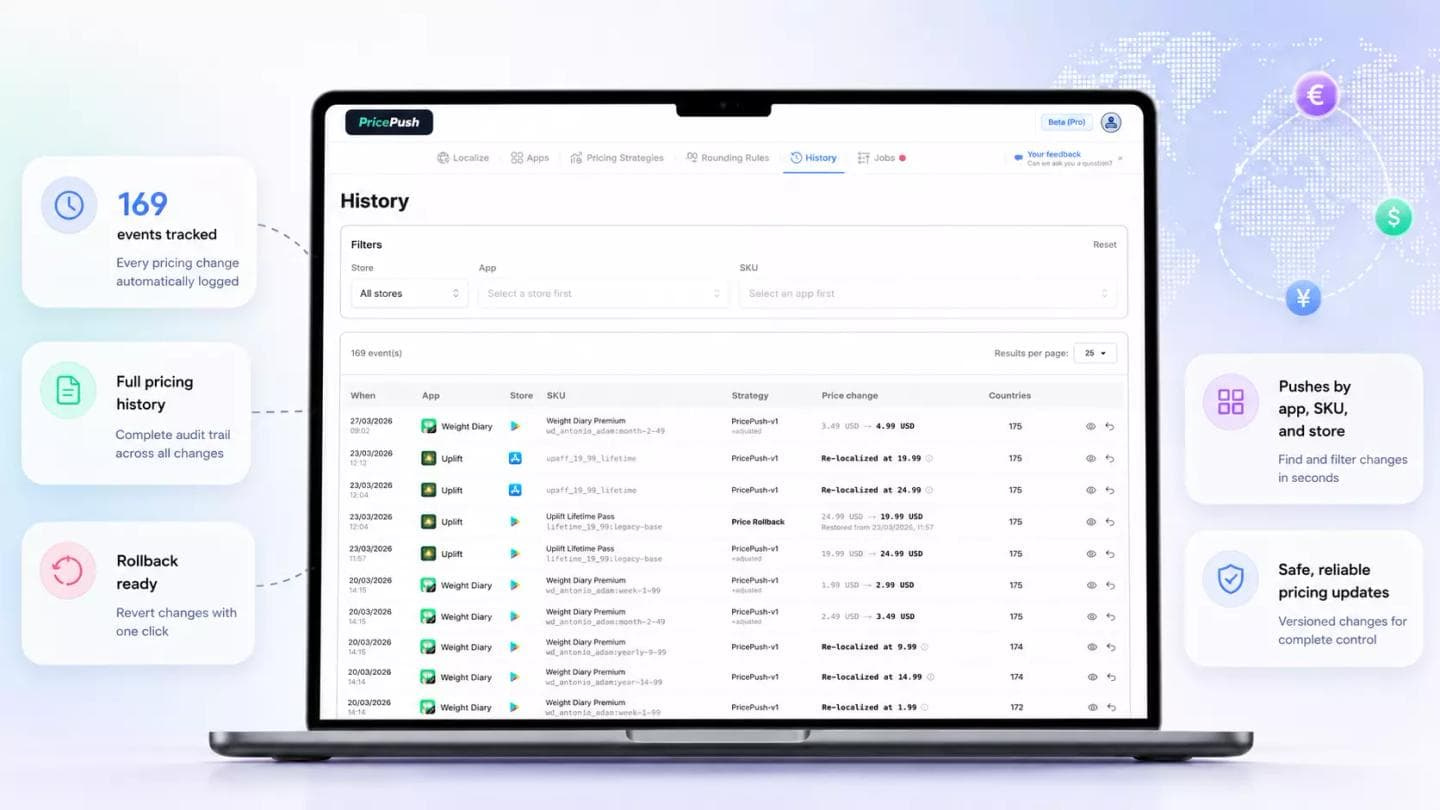
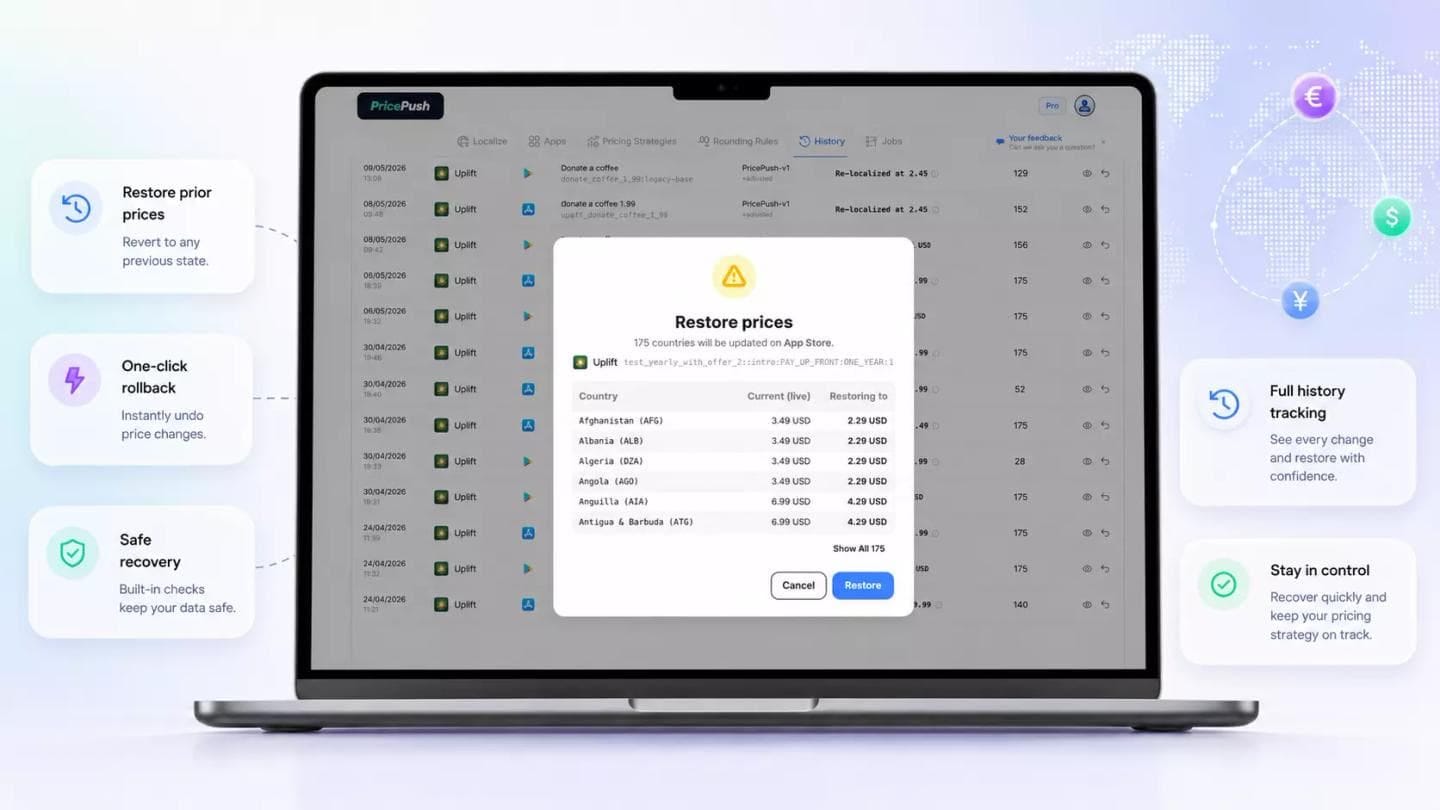
History. The History page lists every push, per app, per product, with per-country diff (old, new, currency), base price, base country, strategy snapshot, and timestamps. Retention is 90 days or 500 events per product, whichever is larger. Restored events show as “Restored” rows pointing back to the push they reverted.
Atomic push. Within a single product on a single store, pushes are job-tracked end to end. The worker batches territories, retries on failure, respects Apple’s rate-limit gate, and records partial-failure state explicitly. Cross-store pushes are two coordinated jobs. If one side fails, the other doesn’t auto-revert, but both states are visible and individually re-pushable.
Rollback. The History page has a Restore action on each row (Pro tier). Click it, and the system re-pushes the old prices from that event, then writes a “Restored from [date]” row to history. No support ticket. It’s a button.
The point isn’t rollback. It’s not pushing the bad change
If you walked away thinking “great, rollback, that’s the thing,” I’d consider this post a failure.
Rollback is a backstop. The thing that keeps you out of trouble is the preview, three steps before the click. Diff, review, ship. The same loop developers run on code, applied to the part of the product that quietly compounds the most revenue.
If preview were flawless and the push were truly atomic, you wouldn’t need rollback. Software isn’t flawless and stores have rate limits, so the safety net exists. The headline should be the diff. Rollback is the safety net behind it.
Questions to ask any pricing automation tool
A checklist honest enough to apply to PricePush too. Use it on whatever you evaluate, this one included.
Can I preview the full diff before any push? Old price, new price, currency, per country, manual overrides flagged. “Preview the strategy but not the resulting prices” is not a diff.
Does each push have a unique ID, timestamp, and status? If you can’t point at “push #1842, completed 14:22 UTC, succeeded in 173 of 175 territories,” your push isn’t tracked.
Are the strategy and base price snapshotted with each push? “I used strategy X with base price Y” should live with the push, not in your memory.
Is the push atomic per product, with retries on transient failures? Half-applied state should be impossible, or when not impossible across systems, explicit and resumable.
Can I see what the price was in country X on date Y? Without an audit trail, “why is this number this number” has no answer.
Can I roll back any past push without contacting support? A button, not a ticket. If rollback is operationally expensive for the vendor, it’ll be expensive for you.
What happens if the push fails halfway through? “Here’s the partial state, here’s the retry, here’s what’s pending” is the honest answer. Not “it should be fine.”
Is there a separate trail for manual overrides versus strategy-generated prices? Otherwise you can’t tell, six months later, whether a country’s price came from your rule or a one-off intervention.
A tool that answers yes to all eight is safe enough for production. A tool that answers yes to four or five gets you most of the convenience but leaves real failure modes undisclosed.
For the why behind regional pricing, see the App Store doesn’t localize your prices. For depth, the complete guide to localized pricing for mobile apps. For the operational counterpart, shipping prices across SKUs and stores.
The takeaway
Automation without safety guarantees is faster manual work. Same blast radius, less time to think.
What you want is automation plus the discipline you use for code: a preview that shows the diff, a commit with an ID, a history that answers per-country questions, an atomic push, and a rollback that’s a button. Versioning, history, and rollback aren’t nice-to-haves. They’re the line between “I push and hope” and “I push and I know.”
I built PricePush because the manual workflow stopped scaling for my own apps. If you want to see versioning, history, and rollback in practice, that’s where it lives.
P.S. The founding lifetime offer is still open while it’s open. If you’ve been on the fence, that’s the cheapest this product will ever be.